

 Arts & Culture
Italy proudly claims the largest share of UNESCO World Heritage sites, boasting 60 officially designated locations as of 2026. Such a dense gathering of architectural, sculptural, and painterly mastery turns any visit into a lifelong pursuit of discovery. This curated collection serves as The Ultimate Guide to Italy’s Art and Cultural Heritage, offering a clear path through centuries of human genius.
Grasping how Italian creativity developed over time requires looking closely at specific historical eras and localized centers of production. You will find a straightforward outline to help recognize major styles and locate the defining works from each period. Acquiring this context lifts a standard holiday into a highly rewarding intellectual adventure.
Origins of Classical Antiquity and Roman Engineering
Long before the Renaissance took hold, the Italian peninsula lay at the center of Roman engineering marvels. Roman architects shook up old building methods by mastering concrete and perfecting the rounded arch to frame massive public spaces. Finished in 80 AD under Emperor Titus, the Colosseum remains a striking illustration of this structural brilliance, once holding upwards of 50,000 onlookers.
Frozen in time, ancient towns yield a rare look into everyday Roman routines and home decor. The volcanic ash of Mount Vesuvius, which buried Pompeii and Herculaneum in 79 AD, preserved wonderfully intact wall paintings and detailed floor tile patterns.
These ancient locations offer the context needed to appreciate why later creators strove to mimic classical antiquity. Walking through these ruins with The Ultimate Guide to Italy’s Art and Cultural Heritage helps you link early building designs to the neoclassical revivals of subsequent eras.
- The Pantheon in Rome, boasting the biggest unreinforced concrete dome on Earth.
- The Roman Forum, which stood for centuries as the beating heart of civic life.
- The Valley of the Temples in Agrigento, Sicily, which preserves spectacular examples of early Greek design outside Greece itself.
The Florentine Renaissance and the Birth of Perspective
The shift from stiff medieval Byzantine art to the lifelike style of the Early Renaissance unfolded mostly in Florence during the 1400s. Back in the early 1300s, Giotto di Bondone paved the way by painting genuine human feelings and spatial depth. Decades later, Filippo Brunelleschi mapped out the geometric rules of linear perspective, completely changing how painters showed distance on a flat canvas.
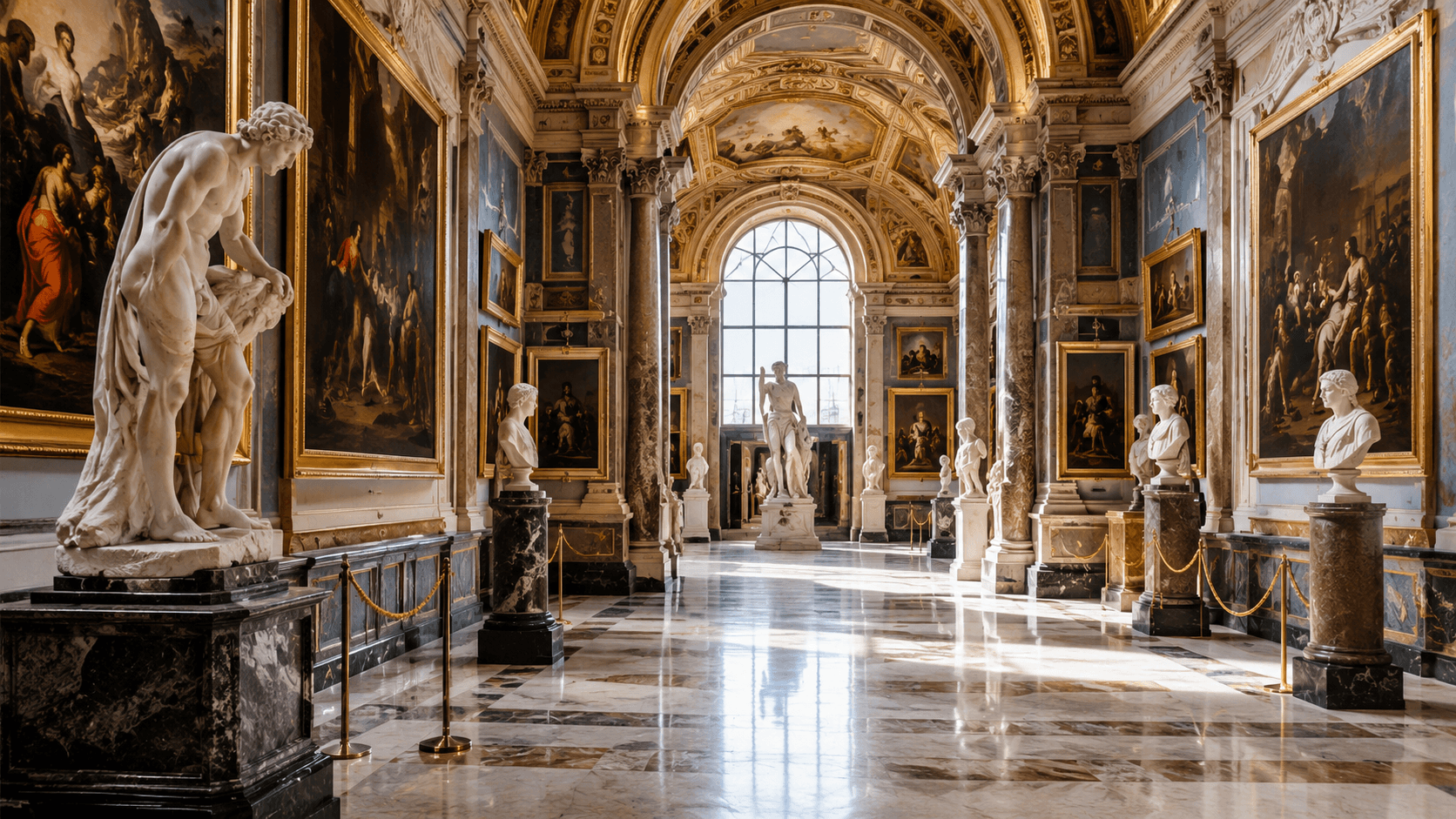
Florence stands as the premier capital for tracking this dramatic turn in human creativity. The Uffizi Gallery displays Botticelli’s famous works, such as the Birth of Venus and Primavera, which highlight pagan myths instead of traditional church scenes. To wander through these immense halls without getting lost, relying on The Ultimate Guide to Italy’s Art and Cultural Heritage helps you focus on the most historically vital masterpieces.
The High Renaissance marked the peak of this artistic growth, steered by figures like Leonardo da Vinci, Michelangelo Buonarroti, and Raphael Sanzio. Michelangelo carved his famous David from a single block of Carrara marble between 1501 and 1504, reaching a level of anatomical accuracy that outshone ancient Greek carvers. Meanwhile, Raphael’s wall paintings in the Vatican, especially The School of Athens, display the harmonious symmetry and deep thought of that golden age.
The Dramatic Contrast of Baroque Masterpieces
By the late 1500s, the intense energy of the Baroque style took hold in Rome, backed by a Catholic Church eager to win back souls. This new wave cast aside the calm balance of the High Renaissance, choosing instead wild motion, raw passion, and sharp visual tension. Caravaggio led this charge with his famous chiaroscuro method, casting deep shadows against brilliant light to stage theatrical, realistic scenes.
Sculptor Gian Lorenzo Bernini pushed past the limits of stone, carving marble to look as fluid and soft as actual fabric or flesh. His sculpture Apollo and Daphne, located in the Borghese Gallery, catches the very second of metamorphosis with fragile stone leaves and warm skin textures. Using the tips in The Ultimate Guide to Italy’s Art and Cultural Heritage allows museum-goers to trace these shifts from quiet Renaissance poses to swirling Baroque action.
- Illusionist ceiling paintings that make flat plaster look like open skies filled with rising angels.
- Dramatic altar pieces that use colored stones and cleverly hidden windows to cast a heavenly glow.
- Twisting, spiraling columns, like the giant bronze canopy designed by Bernini inside Saint Peter’s Basilica.
Navigating Italy’s Diverse Regional Art Schools
Italian art is far from a single, uniform style, existing instead as a patchwork of regional schools shaped by local rulers, trade, and geography. Venetian masters like Titian, Tintoretto, and Veronese put glowing color and soft, humid light ahead of the sharp draftsmanship prized in Florence. This artistic choice grew directly from Venice’s lagoons and its deep commercial ties to Byzantine and Islamic markets.
Down in southern Italy, the cultural landscape reveals a complex mix of Norman, Greek, Arab, and Spanish heritages. Palermo, Sicily’s capital, boasts the Palatine Chapel, where twelfth-century gold tile patterns sit alongside Norman arches and carved Islamic ceilings. This beautiful blend reflects the constant sharing of ideas across the Mediterranean during medieval times.
Consultation with The Ultimate Guide to Italy’s Art and Cultural Heritage during your planning helps lay bare these contrasting artistic minds. You will quickly spot the difference between the intellectual geometry of Tuscany, the warm colors of Venice, and the layered history of the south.
Summary of Key Italian Art Movements
| Artistic Era | Key Characteristics | Defining Work |
|---|---|---|
| Classical Antiquity | Concrete domes, rounded arches, realistic tile designs | The Pantheon (Rome) |
| Florentine Renaissance | Linear perspective, anatomical realism, humanism | Michelangelo’s David (Florence) |
| Baroque Era | Chiaroscuro, intense emotional drama, fluid marble work | Bernini’s Apollo and Daphne (Rome) |
Preserving and Witnessing Italy’s Heritage
Keeping Italy’s vast cultural inheritance safe demands constant scientific care and careful crowd management. Massive crowds visiting fragile environments like Venice or the ruins of Pompeii require clever preservation steps to stop wear and tear. To keep these sites standing, the Italian Ministry of Culture partners with global groups to fund cleanups, like the multi-year scrubbing of Rome’s Trevi Fountain finished in 2015.
Today’s travelers can play a part in these efforts by choosing quiet paths and visiting lesser-known historic spots. Choosing small town museums or quiet archaeological parks spreads tourism money around and takes the physical pressure off overcrowded tourist spots. Checking the advice inside The Ultimate Guide to Italy’s Art and Cultural Heritage helps you uncover these quiet wonders while respecting local conservation rules.
- Secure timed entry passes months ahead of your trip for popular spots like the Scrovegni Chapel or the Last Supper.
- Employ certified local guides who hold university degrees in art history or archaeology.
- Read up on regional history before arriving to grasp the political forces that paid for these creations.
Timeless Masterpieces and Future Journeys
Italy’s artistic wealth stands as one of humanity’s grandest milestones, stretching from the sturdy arches of Rome to the wild drama of the Baroque. Finding your way through this massive collection of works is easiest when you connect historical eras to actual geographic regions. Bringing along The Ultimate Guide to Italy’s Art and Cultural Heritage guarantees a balanced and deeply rewarding look at these enduring creations.
By looking closely at style shifts and regional traits, you will build a deep appreciation for the hands that built Western culture. Thinking ahead and traveling mindfully will keep these sights safe for future generations to enjoy. Ultimately, studying Italian art is a way of looking directly into the human soul.


Comments are closed